
FAQ
We’ve answered the most common questions from our customers – for example, how to correctly dose pool chemicals, how to choose the right filtration system, or how to clean your pool effectively.
Do I really need a filtration system for my pool?
Filtration equipment is essential for the trouble-free operation of any swimming pool. In private pools, the entire water volume should pass through the filtration system at least twice a day, with each filtration cycle lasting approximately 2 to 4 hours (depending on the pool type, usage, load, and weather conditions). For public pools, continuous filtration is recommended to maintain the required water quality.
When selecting a filtration system, it is important to consider the total water volume in the recirculation circuit, the filtration capacity, and the filtration rate. Generally speaking, if the mechanical water treatment is properly designed — preferably slightly oversized — it will be possible to maintain the pool using only a minimal amount of chemical agents.
Which is better — a sand filter or a cartridge filter?
Cartridge filters are suitable only for smaller above-ground pools.
The performance of these filters corresponds to pools with a maximum volume of approximately 5 m³.
For larger pools, it is necessary to use a high-quality filtration unit that ensures effective water circulation and reliable removal of impurities.
Such units include sand filters.
What size filter do I need for my pool?
For private pools, the entire water volume should pass through the filtration system at least twice a day, with each filtration cycle lasting approximately 2 to 4 hours.
When selecting a filtration system, it is therefore important to consider the pool’s total water volume and the pump’s flow rate.
It is generally recommended to slightly oversize the filtration unit for optimal performance.
Recommended sizing:
Pump capacity (m³/h) = Pool volume (m³) ÷ Recirculation time (h)
Example: 40 m³ pool ÷ 4 h = 10 m³/h pump
Why can stainless steel corrode in saltwater pools?
In saltwater pools using electrolysis, stainless steel is not recommended because the process is very aggressive. It can damage stainless steel parts, pool equipment, and even nearby metal components in indoor pools.
If stainless steel must be used — for example, for a ladder — choose AISI 316 grade. However, even this material can start to corrode under certain conditions. Corrosion may appear as small spots at first and later spread over the surface.
The main causes include stray electrical currents, poor grounding, salt deposits, too much chlorine, low pH, and high humidity combined with chlorine vapors.
To prevent corrosion, make sure all components are properly grounded and clean stainless steel parts regularly with a suitable maintenance product.
Do I need to use pool chemicals if I have a filtration system?
To keep pool water clean, clear, and sparkling, it is necessary to carry out chemical treatment in addition to mechanical filtration.
The key parameters to monitor are pH, disinfection level (chlorine or chlorine-free), alkalinity, hardness, and, last but not least, water clarity (turbidity).
Which pool chemicals work best?
The effectiveness of pool chemicals depends mainly on the concentration and quality of the active ingredients. The higher the concentration, the better the effect and the lower the overall consumption. All CHEMOFORM products are highly concentrated and therefore very effective.
Pool chemicals are never made of pure active substances — additional ingredients are needed for safe use, correct dosing, and product stability (for example, in tablets or granules). The quality of these additives also affects the final product.
CHEMOFORM AG manufactures its liquid products using a fully automated, air-free process to ensure high purity and prevent contamination. Tablets are made with a reduced binder content, minimizing unwanted residues in the water.
When choosing between chlorine-based and chlorine-free (oxygen-based) disinfectants, both have advantages and disadvantages.
- Chlorine chemicals are generally the most effective and easiest to measure and dose.
- Oxygen-based products are gentler, suitable even for infants, but require more care and are slightly more expensive.
For best results, always consult a pool professional when selecting and dosing chemicals. Proper use ensures clean, safe water and reduces overall chemical consumption.
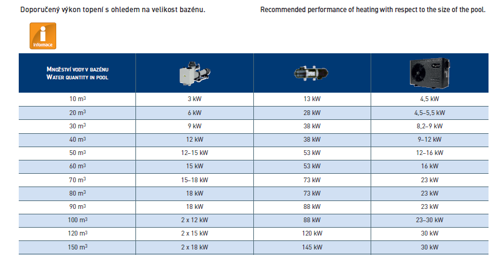
What size heat exchanger / electric heater / heat pump do I need for my pool?
Heating capacity depends on heat losses (insulation, cover), primary temperature (for heat exchangers), pipe length, pool volume, usage, and desired heat-up speed.
The recommended output should always be verified with the pool contractor carrying out the installation, taking into account local conditions and the installation layout.
How can I clean my pool if the water becomes cloudy or green with algae?
The procedure for cleaning pool water is always the same.
Switch the pump to manual mode or extend its operating time (IR – see point 3).
Measure and adjust the main water parameters — alkalinity (80–120 mg/l) and pH (6.8–7.2).
Then perform a shock chlorination using chlorine granules and add a flocculant to remove fine particles.
When using a flocculant, the filter will clog more quickly, so it will be necessary to backwash the filter several times.
Repeat this process until the water is completely clean, the turbidity is removed, and all parameters meet the required water quality values.
How to prepare the pool for winter?
To properly winterize your swimming pool, follow these steps:
- Lower the water level to about 25 cm below the counter-current unit; if there is none, lower it below the return inlets.
- Remove or blow out the water from the pipework (this is usually done by a pool technician).
- Drain all water from the filtration system and all pumps.
- For saltwater pools, rinse all components — such as pumps, heat exchangers, electrolytic cells, and sensors — with fresh water before drying and storing them.
- Store measuring probes in containers with a proper storage solution (never in distilled water) to prevent them from drying out and getting damaged.
- Any easily removable equipment should be stored in a dry and warm place.
- Cover the pool with a protective winter cover and secure it properly.
- During winter, it is advisable to rotate the pump or blower impellers from time to time to prevent the seals from sticking or being damaged before spring start-up.
Stainless steels are alloys of iron and carbon that contain at least 10.5% chromium.
The American Iron and Steel Institute (AISI) recognizes around 60 types of stainless steel as established alloys.
Chromium is the alloying element that gives stainless steel its corrosion resistance, as it reacts with oxygen to form a protective surface layer.
Types of stainless steels
There are four main groups of stainless steels, classified according to their metallurgical structure: austenitic, ferritic, martensitic, and duplex.
In the pool industry, the most commonly used are austenitic stainless steels, which contain approximately 17–25% chromium and 8–10% nickel.
They may also include additional alloying elements to achieve the desired strength properties.
These steels are generally non-magnetic and not attracted to magnets.
The main types of austenitic stainless steels used in pool applications include:
- 1.4301 / AISI 304 / V2A: Cr: 18–20%, Ni: 8–12%
Excellent corrosion resistance in clean, low-contaminant water environments, but not recommended for saltwater use. - 1.4401 / AISI 316 / V4A: Cr: 16–18%, Ni: 10–14%, Mo: 2–3%
The higher nickel content and addition of molybdenum make this steel more resistant to chlorides. - 1.4404 / AISI 316L – Low-carbon steel: Carbon content reduced to 0.01–0.035%.
The lower carbon level prevents chromium carbide formation, thus avoiding local chromium depletion and reducing the risk of pitting corrosion.
Similar protection can be achieved by alloying the steel with titanium or niobium (stabilized grades), such as AISI 316Ti.
Lower carbon content also improves weldability but does not increase strength.
Austenitic stainless steels provide an excellent balance between corrosion resistance and workability, making them ideal for use in pool technology.
Common types of corrosion found in pool environments
The corrosion resistance of stainless steel is due to a chromium oxide layer that forms on the surface when exposed to oxygen.
Once this layer develops, the stainless steel is said to be in a passive or passivated state.
However, there are several factors that can limit the successful use of stainless steels.
Even when the correct grade is selected, its corrosion behavior depends on various conditions such as location, operating environment, concentration, and temperature.
Many corrosion-related problems can be prevented by identifying potential risks in advance and taking appropriate measures to eliminate them.
Internal corrosion
Concentration and temperature:
Aggressive agents (such as certain chlorination chemicals) may be present at various concentrations, either in the environment or in the operating medium.
Acids become more aggressive when diluted to concentrations between 40% and 80%.
Temperature also affects corrosion.
At higher temperatures, chemical and electrochemical reactions accelerate, thereby increasing all corrosion-related activities.
Chloride corrosion:
Pitting may occur on the surface of stainless steel when the protective passive layer is locally damaged.
AISI 316L stainless steel offers good resistance to chloride concentrations and to the levels of other chemicals typically recommended for swimming-pool water.
This material is more resistant to corrosion than AISI 304, particularly in cases of pitting corrosion.
The element most commonly responsible for this type of corrosion is chlorine.
Excessive chloride levels — known as hyperchlorination — can trigger a chemical reaction (sodium hypochlorite, NaClO) that causes highly aggressive corrosion.
To enhance resistance to chlorides, molybdenum (Mo) is added to stainless steel alloys in amounts of 2–3%.
In stainless steel, molybdenum forms chemical compounds that protect the material from pitting corrosion.
Chromium-nickel-molybdenum steels, generally known as stainless steels, are resistant to specific forms of corrosion according to their chemical composition and mechanical properties.
Recommended water chemistry levels for swimming pools
| Parameter | Recommended Range |
|---|---|
| pH | 7.2 – 7.8 ppm |
| Free chlorine | 1 – 3 ppm |
| Calcium hardness | 200 – 400 ppm |
| Alkalinity | 100 – 150 ppm |
| Total Dissolved Solids (TDS) | < 1000 ppm |
| Bromine | 2.0 – 4.0 ppm |
| Copper | 0 ppm |
| Chlorides | < 140 ppm |
| Langelier Index | -0.3 – +0.3 ppm |
How to properly maintain stainless steel surfaces
Recommendations for stainless steel care and maintenance
• Follow the steps and maintenance instructions provided with each accessory.
• All stainless-steel components MUST be properly grounded.
• Avoid dosing chemicals or using aggressive products near stainless-steel elements to prevent corrosion or stains caused by splashing. This includes both pool water treatment chemicals and cleaning/disinfecting agents used around the pool area.
If contact occurs, rinse the affected parts with clean water and dry them.
• Prevent the accumulation of dust, salts, concrete residues, or dirt, and avoid contact with other metallic elements (especially iron), as these factors promote corrosion.
• Construction materials and chemicals are not suitable for stainless steel. Avoid installing stainless-steel accessories during construction or cleaning phases; whenever possible, install them only after the area is completed and cleaned.
If early installation is unavoidable, rinse all stainless-steel parts with water and dry them once construction work is finished.
• Stainless-steel products should be stored properly packed in a clean, dry, and suitable location — always separately and away from chemicals that could create a corrosive environment.
• Handle stainless-steel accessories carefully during installation. Avoid impacts or scratches, as these can damage the passive protective layer and lead to pitting corrosion.
• After installation, stainless-steel parts (especially ladders) should be used only for their intended purpose — never as supports or platforms for dosing pool chemicals.
Chemicals should always be added to the water away from stainless-steel components whenever possible.
Cleaning agents that should NOT be used on stainless steel:
• Cleaners containing chlorides, especially hydrochloric acid–based products.
• Chlorine bleach should not be used on stainless steel. If it is accidentally applied or splashed, rinse the surface immediately with clean water.
• Silver cleaners should not be used on stainless steel.
To avoid cross-contamination with iron particles, make sure cleaning materials have not been previously used on carbon steel or ordinary steel.
It is recommended to use separate cleaning tools and materials exclusively for stainless steel.
Care and maintenance of stainless steel
Cleaning and maintenance
Although stainless steels are generally corrosion-resistant materials that do not require additional surface protection to enhance their appearance or durability, regular cleaning and maintenance are essential to ensure that stainless-steel surfaces remain in good condition. Proper care helps preserve both their aesthetic appearance and corrosion resistance.
The purpose of these recommendations is to support installation companies and pool owners in carrying out effective cleaning procedures to fully benefit from the anti-corrosion properties of stainless steel.
Regular cleaning removes residues such as lime scale, chlorides, and other harmful substances that may adhere to the steel surface and cause pitting corrosion.
Cleaning frequency
The cleaning frequency depends on the environmental and weather conditions to which the product is exposed, as well as on the grade of stainless steel used:
| Environment | +6 months | 3–6 months | 1–3 months |
|---|---|---|---|
| Rural | AISI 304 (1.4301) | – | – |
| Urban | AISI 316 (1.4401) | AISI 304 (1.4301) | – |
| Industrial | – | AISI 316 (1.4401) | AISI 304 (1.4301) |
| Marine | – | AISI 316 (1.4401) | AISI 304 (1.4301) |
Recommended cleaning method
Use phosphoric acid or nitric acid–based cleaners or pastes, and always use nylon brushes (never steel brushes).
After cleaning, rinse thoroughly with clean water.
This ensures the product remains in perfect condition and maintains its corrosion resistance.
Additional recommendations
- High-quality stainless steel such as AISI 304 (1.4301) can withstand many types of pool water, provided the chemical concentrations, particularly residual chlorine (chloramine) levels, remain within recommended limits.
- In indoor pools, the environment is generally more aggressive due to higher concentrations of corrosive chemical vapors, so more frequent cleaning is essential.
- In the most aggressive environments — such as coastal areas, industrial zones, or saltwater pools — we recommend using AISI 316 (1.4401) stainless steel, which offers greater corrosion resistance due to its higher nickel content and the presence of molybdenum (Mo).
Stainless steel in saltwater electrolysis pools
We do not recommend the use of stainless steel in pools equipped with saltwater electrolysis systems. Any resulting corrosion cannot be recognized as a warranty claim.
The salt concentration in pools using salt chlorination systems typically ranges between 3.5 g/l and 5 g/l (for comparison, wastewater contains around 50 g/l of salt).
This level of salinity does not normally damage stainless steel, although it is recommended to use AISI 316-grade components.
What truly harms stainless steel are high salt concentrations, even for short periods of time.
When starting up a salt chlorination system, a large amount of salt is often added to the water.
If stainless-steel accessories are exposed to these high salt concentrations near the dosing area, the surface will begin to deteriorate — first showing stains or discoloration, which then spread along the welds and eventually across the entire component.
The best practice during the initial filling and salt dosing process is to remove stainless-steel accessories from the pool and reinstall them after the salinity level has stabilized at its normal operating range.
Always ensure proper grounding and bonding of all stainless-steel elements.
Users of heat pumps often complain about low performance or visible smoke coming from the unit during colder periods.
In most cases, this is not a malfunction, but a normal characteristic that can be easily explained by basic physics.
Why is my heat pump not heating properly or losing performance?
As the temperature difference between the pool water and the surrounding air increases, heat loss through the pool surface also becomes greater.
Even a covered pool with an uncovered water surface experiences significant heat loss — the water effectively heats the air space under the cover.
This naturally places higher demands on the heat pump.
The efficiency of a heat pump also decreases as the outdoor air temperature drops.
Example:
Heat pump Rapid Inverter (565RIC040)
- At an air temperature of 26 °C and 80 % humidity, the unit provides a heating capacity of 15 kW with a COP of up to 16.
- At +5 °C, the heating capacity drops to approximately 7 kW with a maximum COP of around 6.
- At –5 °C, the heating capacity is only about 5.5 kW, with a maximum COP just above 4.
So, the heat pump is heating, but at lower outdoor temperatures it cannot fully compensate for the pool’s heat losses.
As a result, during the night, the pool temperature may drop by more than 2 °C.
In practice, this means the heat pump heats the pool water by about 2 °C during the day, but this heat is lost again overnight.
For the user, this situation can create the impression that the heat pump is not heating or functioning correctly, even though it is operating as expected under the given conditions.
Why is my heat pump smoking, steaming, or freezing over?
When the ambient air temperature drops below 12 °C and humidity is high, condensation on the evaporator of the heat pump begins to freeze.
For this reason, heat pumps are equipped with an automatic “defrost” mode. During this cycle, the hot refrigerant is redirected by a four-way automatic valve directly into the evaporator, which causes the frost to melt instantly.
During this process, steam rises from the heat pump — it is not smoke.
Automatic defrosting is a feature found in mid-range and high-end heat pumps, allowing the unit to operate effectively even at low outdoor temperatures.
Aside from regular maintenance — such as cleaning the fan filter and evaporator — it is also important to ensure optimal operating conditions for the dehumidifier.
This mainly means providing sufficient ventilation in the pool hall.
Why should I ventilate the pool hall?
Because pool water becomes contaminated by microorganisms introduced by swimmers, it must be disinfected.
The most common disinfectant is chlorine or its “alternative” — saltwater chlorination.
When chlorine is dosed or generated in the water, it produces free chlorine, which provides the strongest disinfection effect.
When free chlorine reacts with organic impurities, particularly those containing nitrogen (such as sweat and urine), combined chlorine is formed.
One of its byproducts, nitrogen trichloride (trichloramine) — along with monochloramine and dichloramine — is a gaseous compound produced by combined chlorine.
Due to its poor solubility in water, trichloramine evaporates from the water surface similarly to water vapor and accumulates in the surrounding air.
Air saturated with trichloramine in an unventilated room is extremely harmful not only to living organisms but also to everything present in the enclosed space.
Such an environment is highly aggressive and can cause the rapid degradation of both pool equipment and structural elements of the building.
Why does this matter?
In pool halls where a dehumidifier is installed, it is essential to ensure regular air exchange.
If the air is not refreshed frequently, the concentration of trichloramines in the atmosphere will increase, and trichloramine vapors will begin to settle inside the dehumidifier and on all surrounding equipment.
Within a short time, this can cause irreversible damage to all devices — including corrosion of metal parts and even degradation of non-metallic materials.
Therefore, always ensure sufficient air exchange in the pool hall — not only to maintain the long service life and reliable operation of the dehumidifier (and other nearby equipment), but also to protect the health and safety of pool users.